


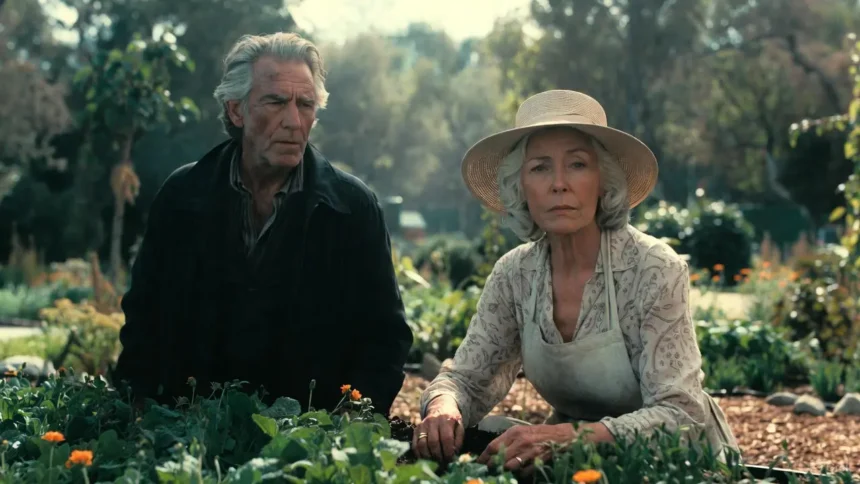
Arthur Hale heard the doctor’s words the way a man once at sea hears thunder on the horizon — factual, far-off, impossible to argue with. “We’re looking at about six months,” the doctor said. Arthur blinked, folded the pamphlets into his coat pocket, and walked out of the clinic with a new measurement for time: one that came in small, sharp units.
He was seventy-one, a shipwright by trade and a man who had learned patience from salt and oak. His wife, Marianne, had been gone five years. Since then his house by the harbor had been full of memory and teacups, the echo of laughter that grew thinner with each year. He had not expected company. He had not expected a garden.
The hospital garden was wedged between red brick and the glass of the oncology wing — a narrow, stubborn parcel of green where volunteers pushed at soil like they were straightening the world. Arthur had seen it from the scanner room window, a square of maple shadow and raised beds. He wandered there one morning because he needed the ordinary: the smell of earth, the honest smallness of a task.
The woman in the sunhat was kneeling among the beds, fingers threaded into dirt. She introduced herself as Clara, sixty-seven, a volunteer who’d taken to the garden after losing her husband. Her laugh arrived like the small, steady chime of a bell. She talked about compost like it was a living language and handed Arthur a trowel as if he were family.
“Most people don’t notice this place,” she said, wiping her palms on her apron. “They come for scans and leave. But this spot—” She gestured to a crooked line of budding tulips. “—this is where people remember how to breathe.”
Arthur found himself telling her about Marianne while his hands absently brushed the roots of a fledgling plant. He told her about the slips of paper Marianne folded into his pocket for luck, the way she taught him to coax a stubborn sail into obeying. Clara listened as if each sentence mattered, as if stories were seedlings that required tending.
Their mornings became a rhythm. Arthur scheduled treatments so they dovetailed with Clara’s volunteer shift. Nurses noticed that he came back from scans brighter, that he spoke more in full sentences. “He’s smiling,” one tech confided to another, and the word travelled like a benediction through the ward.
There was no rush. Their days were stitched together from small acts: Clara bringing ginger-mint tea in a dented thermos; Arthur carrying shortbread from his neighbor in a paper tin. They traded the kind of humor only age and loss can produce.
“I killed a cactus once by over-watering it on purpose,” Clara admitted one morning, tucking a seed packet into her apron pocket. “I was trying to save it with too much love.”
Arthur grinned. “My mother used to say men fix things to prove they’re useful. It usually ends in a trip to the hardware store and a lecture.”
The laughter became a kind of medicine; sometimes it worked better than his pills. It was not that the diagnosis retreated — scans still arrived, and chemo days were honest in their pain — but there were mornings that held sunlight instead of dread.
Clara had rituals too. She kept a pocketful of seed packets and small printed notes that read, simply, “Plant hope.” When they sat on the bench under the maple, they read to each other sometimes: a paragraph from a book, a weathered poem, or a letter clumsily folded in Marianne’s handwriting that Arthur had kept all these years. Clara would smooth the paper like it was part of a bed they both tended.
One evening, the hospital organized a volunteer appreciation night in the garden. Lanterns dangled from the maple; someone had dragged an old record player outside. The chill in the air did not matter — there were blankets and thermoses and the hush of people glad to be together.
“You clean up nice,” Arthur told Clara when she arrived in a blue dress instead of her sunhat.
She pretended to consider the compliment. “It’s a special occasion. My apron has gone to the cleaners for the night.”
They danced on the grass, slow and a little off time. Arthur felt his ribs hollow out with something that was less fear and more astonishment. Under the lanterns, people clapped for a choir of volunteers and the maple leaves whispered like an audience.
After that night, the idea began as a small, ridiculous seed: what if, they joked, the garden could be turned into something like a chapel? It was a tender, half-formed thought. Arthur found he liked imagining it — the way the table could be set with paper cups, the way the bench could hold small, treasured faces.
He was practical in the way of men whose lives had been measured in beams and joints. So he spoke plainly one afternoon while they pruned an over-eager rosemary.
“I can’t promise a long future,” he said. The words caught on the air. “The doctors gave me six months, Clara.”
She didn’t flinch. “I know,” she said. Her hands were steady at the stem. “You don’t have to explain.”
“I don’t want to—” he searched for a word that would not wound. “I don’t want to put you in pain if it gets worse.”
Clara paused and looked at him like someone who had read long seasons of grief and still believed in the sun. “Arthur, I have already lost,” she said. “Grief doesn’t mean we stop wanting company. It means we know what to value.”
It was not a grand speech. It was simple, true, the kind of reply that roots itself in both people.
They agreed, half in jest, to imagine a wedding. The hospital staff — who’d held other kinds of ceremonies in front of miracle machines — listened and smiled. When Arthur asked the chaplain if it was possible to hold a small ceremony among the beds, the chaplain said, “Of course. Love is work. This garden is work, too.”
The garden became their project. Nurses helped with ribbons, a local florist donated bunches of rosemary and lemon leaves, and Clara’s book club made place cards. Friends and neighbors who had been quiet fixtures in Arthur’s life appeared like surprise confetti: a shipwright apprentice, a neighbor who made shortbread, the deli owner who always remembered how Arthur liked his bread sliced. They brought folding chairs and stories.
On the morning of the wedding, the maple filtered light like an old instrument. Arthur wore his father’s jacket, sleeves carefully shortened at the elbow by someone who knew how to measure for comfort. Clara’s dress had pockets big enough for seed packets — she tucked them in, smiling at him.
When they stood before the chaplain — an easy man with a habit of printing his sermons by hand — they read vows that sounded like weathered promises.
Arthur’s voice held the timbre of someone who had learned to keep things steady. “I can’t promise eternity,” he said. “But I promise this: every morning I wake, if I can, I will choose you. I will make tea and carry the shortbread and I will remember Marianne with you, because memory is not competition — it’s company.”
Clara’s vow was a small, fierce thing. “I will plant with you,” she said. “I will tend the rose and the rosemary, and I will be here on hard days and on good ones. I will not pretend the clock doesn’t tick, but I will count the moments.”
A nurse dabbed at her eyes with a folded handkerchief; an apprentice clapped like he’d seen a good knot tied. The chaplain smiled and declared them married with the quiet joy of someone who’d spent a life stitching together other people’s promises.
They kissed then — softly, like a benediction. People called it brave; Arthur later said it felt like the most ordinary, right thing in the world.
After the wedding, their life was full of small, practical tenderness. Clara made tea every morning and Arthur carved a planter box with the words Second Chances Grow Here. They adopted a scruffy little dog from a shelter who fit on Arthur’s lap like a lost mitten. They spent afternoons clearing a bed, reading at the bench, mending old sweaters, arguing gently about when to prune roses and when to leave blooms for the bees.
The scans still came. There were nights when the pain would not be soothed and a nurse would sit in the kitchen with them until the kettle stopped steaming. But on many days, sunlight poured into the garden and those days were wide enough for memory and love.
One autumn evening, sitting on their bench with lavender between them and a sky that had the clarity of well-kept things, Arthur squeezed Clara’s hand. “I came here thinking I was at the end,” he said. “But the end was never a moment. It was a season. And seasons can have springs.”
Clara leaned her head on his shoulder. “We kept planting,” she said. “So of course we found flowers.”
Arthur looked over the beds they had tended — marigolds nodding, roses catching the last of the light — and felt a gratitude that had the shape of a harbor: protected, deep, and steady.
If you’re holding a diagnosis, a calendar, or a fear that feels too large, remember the bench in the hospital garden. Choose small kindnesses. Let sunlight in. Tend what you can. Love may not extend the number of days you’re given, but it can make those days reach farther than you thought possible.